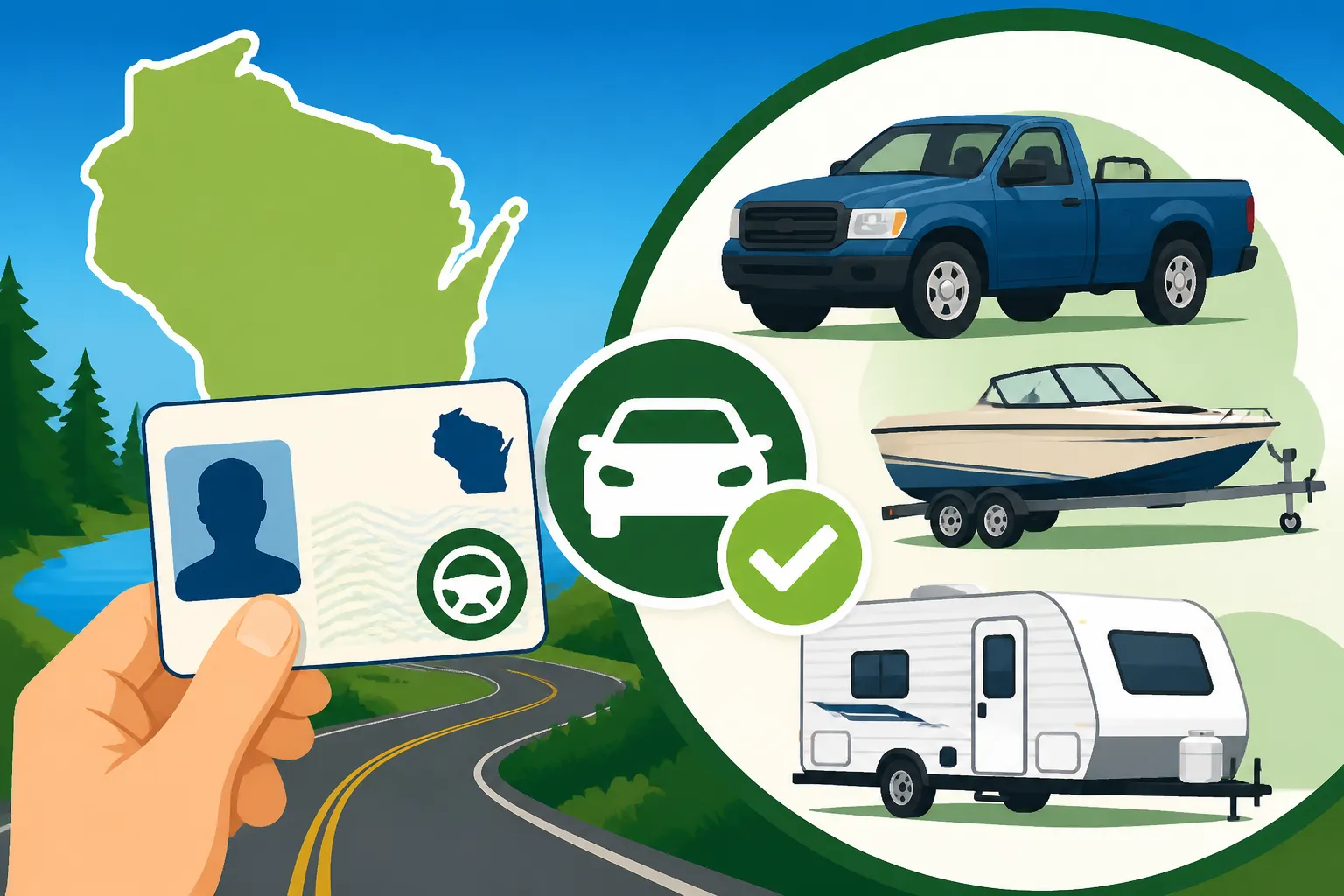
Wisconsin Class D Driver’s License: Weight Limits and Vehicles Allowed
A Wisconsin Class D license is the ordinary license most people use to drive cars, SUVs and light trucks. But questions arise when a vehicle is heavy, carries many passengers or pulls a trailer. The key is to look beyond the vehicle’s size: its weight rating, purpose and passenger capacity can all affect whether a Class D license is enough.
What a Wisconsin Class D License Covers
A Class D license is Wisconsin’s regular, noncommercial driver license for operating most passenger vehicles. It generally covers cars, SUVs, pickups and vans that do not require a commercial driver license or another class or endorsement. It is not a blanket authorization for every vehicle that can be driven on a public road.
The Class D category sits within a broader system of license classes and endorsements. A different license class may be required for a motorcycle or certain commercial vehicles; an endorsement may be needed for particular duties or vehicle types. For a wider comparison, see Wisconsin Driver License Classes and Endorsement Rules.
The short answer on weight
The number often discussed is 26,001 pounds. For commercial motor vehicles, a vehicle with a gross vehicle weight rating (GVWR) of 26,001 pounds or more generally falls into a CDL category. A qualifying combination vehicle can also require a CDL based on the combined ratings and the rating of the vehicle being towed.
That does not mean that every private vehicle over a certain weight automatically requires a CDL. CDL rules focus on whether a vehicle meets the legal definition of a commercial motor vehicle and on its characteristics and use. Personal recreational vehicles may be treated differently from commercial vehicles. Because that distinction can matter, do not rely on the weight number alone when deciding whether a Class D license is sufficient for a heavy motorhome or another unusual vehicle.
For an ordinary passenger car or light truck used privately, a Class D license is generally the appropriate license. If a vehicle is unusually heavy, carries a large number of people, is used for work or pulls a heavy trailer, check the vehicle’s ratings and the applicable WisDOT requirements before driving it.
Class D is not a vehicle registration category
A driver license answers whether you are licensed to operate a vehicle. It does not, by itself, confirm that the vehicle is registered, insured, equipped or being used lawfully. Those are separate questions, with their own requirements.
Likewise, a vehicle’s title or registration does not show that a particular driver has the right class or endorsement. Check each part of the situation separately: the license, the vehicle’s registration and insurance, and any rules that apply to its use.
How to Read the Weight Ratings
A vehicle can look small and still have a high weight rating, or look large without reaching a CDL threshold. The useful figure is usually the rating assigned by the manufacturer, not a guess based on the vehicle’s size or how much it weighs on a particular trip.
GVWR and actual weight are different
GVWR means gross vehicle weight rating: the maximum loaded weight the vehicle is designed to carry, as specified by its manufacturer. It is a rating, not a scale reading. It accounts for the vehicle and its occupants, cargo, fuel and other loads.
This distinction matters because a vehicle rated above a threshold does not fall below it just because it is carrying little or no cargo. Conversely, a lower-rated vehicle may be overloaded even if its rating does not place it in a CDL category. Overloading is a separate safety and compliance issue.
Look for the vehicle’s certification label, commonly located on the driver-side door area, and check the owner’s manual or manufacturer information if the label is missing or hard to interpret. Use the rating that applies to the specific vehicle, not an estimate based on its appearance.
Combination ratings matter when towing
When a vehicle pulls a trailer, the question may involve more than the tow vehicle’s rating. Commercial licensing rules can depend on the combined weight ratings of the power unit and trailer, as well as the trailer’s own GVWR. In broad terms, certain combinations with a combined rating of 26,001 pounds or more can require a CDL when the towed unit is rated above 10,000 pounds.
These are screening thresholds, not a substitute for checking the actual rule that applies to the vehicle and use. Trailer type, vehicle ratings and whether the operation is commercial can all affect the result. Do not use the trailer’s empty weight as a stand-in for its rating.
A quick comparison
| What to check | What it tells you | Why it matters |
|---|---|---|
| Vehicle GVWR | The manufacturer’s maximum rated loaded weight for the vehicle | Helps identify whether a commercial vehicle may meet a CDL weight threshold |
| Trailer GVWR | The trailer’s maximum rated loaded weight | Can affect whether a commercial combination requires a CDL |
| Combined rating | The applicable ratings for the power unit and trailer together | Can trigger a different CDL category for some commercial combinations |
| Passenger design capacity | How many people the vehicle is designed to carry | A commercial vehicle designed for 16 or more people, including the driver, can require a CDL |
| Vehicle use | Whether the vehicle is being operated commercially or privately | CDL rules are not determined by weight alone |
| Required placards | Whether hazardous materials rules apply | A vehicle transporting certain hazardous materials may require a CDL with a hazardous materials endorsement |
For a focused explanation of weight-related CDL thresholds, see Over 26,000 Pounds GVWR: When You Must Take a CDL Exam. If the combination or vehicle type is complicated, check the applicable Wisconsin rules with WisDOT before driving.
Vehicles Most People Can Drive With Class D
For routine personal driving, a Class D license typically covers the vehicles people use for commuting, errands and family travel, provided the vehicle does not fall into a category that requires a CDL, a motorcycle license or another qualification.
Passenger cars, SUVs and light trucks
A regular passenger car, minivan, SUV or light pickup used for personal transportation is generally within the ordinary Class D category. Drivers still need to follow any restrictions shown on their license and any separate rules that apply to the vehicle.
A larger pickup is not automatically a commercial vehicle just because it has a substantial frame or can carry a heavy load. Check its GVWR and how it is used. The same principle applies to cargo vans: the model name or body style alone does not settle the licensing question.
Vans and passenger capacity
The number of seats is important when a vehicle is used commercially. A commercial motor vehicle designed to transport 16 or more people, including the driver, generally falls within CDL requirements even if it is not especially heavy. The count concerns the vehicle’s design and capacity, not simply how many people happen to be riding on one particular trip.
A privately used passenger van may be treated differently from a vehicle operated as part of a commercial service. That difference does not remove the need to check other applicable rules, such as insurance, vehicle equipment or restrictions on a particular license. Do not assume that a van is Class D-eligible solely because it is commonly sold to families.
Mopeds and motorcycles
A valid Wisconsin driver license can satisfy the operator-license requirement for a moped, subject to applicable restrictions. A moped is not the same as a motorcycle for licensing purposes. A Class D license does not, by itself, authorize operation of a motorcycle; that requires the appropriate motorcycle class or qualification.
For motorcycle-specific rules, start with the state’s current requirements for a Class M license and any permit or testing steps. A vehicle’s low speed or small engine does not necessarily make it a moped under the legal definition.
For another plain-language overview of common vehicles and license categories, see What Vehicles Can You Drive Legally with a Standard Wisconsin License?.
Tractors and specialized vehicles
A vehicle used off public roads, on private property or in a specialized occupation may be subject to rules that differ from ordinary passenger-car licensing. Some specialized or agricultural operations have exceptions, but an exception should not be assumed to apply just because a vehicle is a tractor, farm truck or work vehicle.
Before operating a specialized vehicle on a public road, confirm both the driver-license requirement and the vehicle’s registration, equipment and operating rules. The answer may depend on the vehicle’s configuration, the trip and the purpose of the operation.
Heavy Vehicles, Commercial Use and CDL Boundaries
A Class D license is not the license to use for a vehicle that meets Wisconsin’s commercial driver licensing requirements. The key question is not simply, “Is this vehicle heavy?” It is whether the vehicle or combination fits a CDL category under the applicable rules.
The main CDL triggers
A commercial motor vehicle may require a CDL when it meets one or more of these general criteria:
- It has a GVWR of 26,001 pounds or more.
- It is a combination vehicle with a combined rating of 26,001 pounds or more and a towed unit rated above 10,000 pounds.
- It is designed to transport 16 or more people, including the driver.
- It transports hazardous materials that require placards.
These are general categories to help identify when more research is needed. The complete rule can include definitions, exceptions and additional conditions. Commercial operation, vehicle configuration, the type of cargo and the required placards can all matter.
A driver who needs a CDL must obtain the appropriate class and endorsements. A Class D license does not become a CDL simply because the driver has years of experience or because the vehicle is used only occasionally. Review Commercial Driver License Testing and Evaluation Standards for more on the licensing process.
Work use can change the answer
The same type of vehicle may be subject to different licensing rules depending on how it is used. A light truck driven privately is not automatically a commercial motor vehicle. But a vehicle used in a business, for transporting people or goods, or in another commercial operation may need closer review.
Do not treat “commercial” as a synonym for “large.” The legal definition depends on the rules that apply to the vehicle and the operation. If an employer, client or vehicle owner assigns you to drive a vehicle, ask for the vehicle’s GVWR, the trailer’s GVWR if applicable, passenger capacity and any hazardous-material placarding information. Then confirm the license class and endorsements required.
Personal motorhomes and recreational vehicles
A private motorhome can be heavier than a typical passenger vehicle. It is a mistake to assume that the 26,001-pound CDL threshold applies in exactly the same way to every recreational vehicle. A personal-use RV may be treated differently from a commercial motor vehicle, while an RV used in a business or to transport passengers for compensation may raise other licensing questions.
Before driving a heavy motorhome with a Class D license, check its GVWR, how it will be used and the current Wisconsin requirements for that exact type of vehicle. If towing a car or trailer, check the ratings for the whole combination too. Do not rely only on a general statement that “RVs do not need a CDL” or “anything over 26,000 pounds needs one.” Both can be incomplete without the details.
Medical and testing requirements
CDL holders have additional qualification requirements that do not necessarily apply to an ordinary Class D driver. Depending on the CDL class and endorsement, these can include knowledge tests, skills tests and medical or hearing-related screening requirements.
If your vehicle falls into a CDL category, learn the full process before taking the wheel. Wisconsin CDL Hearing and Vision Screening Requirements explains screening considerations, while Preparing for the Wisconsin CDL Vehicle Inspection and Driving Test can help clarify what to expect during vehicle and skills testing.
Towing a Trailer With a Class D License
A Class D license does not mean that every trailer combination is automatically permitted. The vehicle ratings, trailer ratings, commercial use and cargo can change the answer. Even when a CDL is not required, other rules may apply to safe and lawful towing.
Check the tow vehicle and trailer ratings
Before towing, find the tow vehicle’s maximum towing capacity and the trailer’s GVWR. These are related but not interchangeable numbers. The tow vehicle’s capacity tells you what its manufacturer allows it to tow under specified conditions; the trailer’s GVWR is its maximum rated loaded weight.
Also check the vehicle’s payload rating and any limits for the hitch, tires and other equipment. A combination can be within a licensing threshold yet still exceed the manufacturer’s safe operating limits. Licensing eligibility is not a safety certification.
Know when the combination needs more review
For commercial combinations, a combined rating of 26,001 pounds or more, paired with a towed unit rated above 10,000 pounds, can trigger a CDL requirement. For a private-use combination, the analysis may differ. Since the rules can turn on both use and ratings, get the exact vehicle and trailer information before deciding that a Class D license is enough.
Do not base the decision on the trailer’s current load alone. A lightly loaded trailer can still have a high GVWR, and a heavily loaded trailer can create an overloading problem even when its rating is below a CDL threshold.
Consider the vehicle’s handling, not just the license
A vehicle-and-trailer combination requires more space to stop and turn, and it can be harder to control in wind or on uneven pavement. Before a trip, check that the hitch and safety equipment are suitable, the load is secured and the lights and brakes work as required. Follow the tow vehicle and trailer manufacturers’ instructions.
For commercial drivers, required pre-trip inspections and vehicle standards are part of the licensing and operating obligations. For private drivers, careful checks still matter even when a commercial inspection rule does not apply.
How to Confirm Your License Is Enough
When a vehicle’s weight, passenger capacity or use is close to a licensing threshold, verify the details before driving. A short check can prevent a license violation, an insurance problem or a decision to operate a vehicle that is not safe for the combination.
A practical checklist
- Identify the vehicle accurately. Record its make, model and model year, and check the certification label for its GVWR.
- If towing, check both vehicles. Find the tow vehicle’s rating, trailer GVWR and applicable combined rating. Do not substitute an estimate of the current load.
- Count designed passenger capacity. Include the driver when checking whether a commercial passenger vehicle meets a threshold.
- Clarify how the vehicle will be used. Note whether it is personal, business-related, used to transport passengers or cargo, or carries hazardous materials.
- Check for special categories. A motorcycle, CDL vehicle or vehicle requiring an endorsement may not be covered by Class D.
- Review restrictions on your license. Restrictions can affect what and when you may drive, even if the vehicle otherwise fits Class D.
- Confirm the rule with WisDOT. Give the agency the ratings and details of the actual use. Ask which license class and endorsements apply before operating the vehicle.
If you are still preparing for a regular driver license, keep study resources separate from vehicle-class decisions. A commercial course such as I Drive Safely may help structure general study, but use WisDOT’s current information to confirm Wisconsin licensing rules.
Keep separate requirements separate
A license check is only one part of being ready to drive. Depending on the vehicle, you may also need to confirm registration, insurance, equipment requirements, passenger rules and restrictions on cargo or towing. A Class D license does not make an otherwise unregistered or unsafe vehicle lawful to operate.
If a trip involves a business vehicle or an unfamiliar trailer, get the information from the owner or employer before leaving. If the vehicle is borrowed, do not assume the owner’s license category or prior use proves that your own license is sufficient.
Frequently Asked Questions
Does a Wisconsin Class D license have a 26,000-pound weight limit?
The 26,001-pound threshold is important for commercial motor vehicle CDL rules, but it is not a universal rule that every private vehicle above that rating requires a CDL. Vehicle type and use matter. Confirm the Wisconsin requirements for a heavy personal-use vehicle, especially a motorhome.
Can I drive a pickup with a Class D license?
Generally, yes, if it is an ordinary pickup that does not meet a CDL category and your license has no relevant restriction. Check its GVWR and how it will be used, particularly if it is a heavy truck or is towing a trailer.
Can I drive a 15-passenger van with a Class D license?
Passenger capacity alone does not answer every case. CDL requirements generally apply to commercial vehicles designed to carry 16 or more people, including the driver. A vehicle with fewer seats may still require further review based on its use, weight or other features.
Does Class D let me drive a motorcycle?
No. A Class D license does not by itself authorize motorcycle operation. You need the appropriate motorcycle class or qualification.
Does a trailer’s actual weight determine whether I need a CDL?
Not by itself. Commercial licensing rules can depend on the trailer’s GVWR and the combination’s ratings, rather than only the weight on the day of the trip. Check the ratings and whether the operation is commercial.
Disclaimer
This article is for general informational purposes only and does not constitute professional advice. Laws, prices and regulations vary by location and change over time. Consult a qualified professional for guidance on your specific situation. Wisconsin Driver Guide is not a government agency and is not affiliated with any state motor vehicle department.