Wisconsin Non-Compliant License vs REAL ID: Rules and Key Differences
A Wisconsin driver’s license can be valid for driving without being REAL ID-compliant, which makes the labels easy to confuse. The practical difference is whether the card meets federal identification standards for certain uses—not whether it gives you permission to drive. Here’s how to read the marking, think through your identification needs, and check what to do next.
What “non-compliant” and REAL ID mean
A Wisconsin driver’s license or identification card can have a state-issued purpose while differing in whether it meets federal identification standards. “Non-compliant” refers to that federal-use status. It does not, by itself, describe the person’s driving ability, license class, or driving history.
A REAL ID-compliant card is a credential that meets the relevant federal standards for identification. Depending on the situation, a compliant credential may be accepted for certain federally regulated purposes. The exact identification rules can depend on the destination, facility, and current federal requirements, so check with the organization or agency involved before relying on a particular card.
Wisconsin Department of Transportation states that non-compliant Wisconsin driver licenses and ID cards are marked NOT FOR FEDERAL PURPOSES. The wording is a clear signal that the card is not intended to serve as a federal-purpose credential. It does not mean the card is fake or that it has no use.
The distinction is easiest to understand by separating three questions:
- Can you drive? That depends on your driving privilege and the status of your license, not simply whether the card is REAL ID-compliant.
- Can you use the card as identification? That depends on the organization accepting it and the identification rules for the specific transaction.
- Can you use it for a federal purpose? That depends on whether the purpose requires a REAL ID-compliant credential or another accepted form of identification.
A driver’s license is both evidence of driving authorization and a form of identification. Those roles overlap, but they are not identical. A non-compliant card may still be useful for state or everyday identification purposes, while not meeting a federal identification requirement. Conversely, being REAL ID-compliant does not add driving privileges or change the vehicles you may operate.
For help identifying the marking on your card, see How to Check if Your Wisconsin Card Is REAL ID Compliant. If the card says NOT FOR FEDERAL PURPOSES, treat that text as a warning to check the identification rules for your intended use rather than assuming the card is invalid for everything.
Key differences at a glance
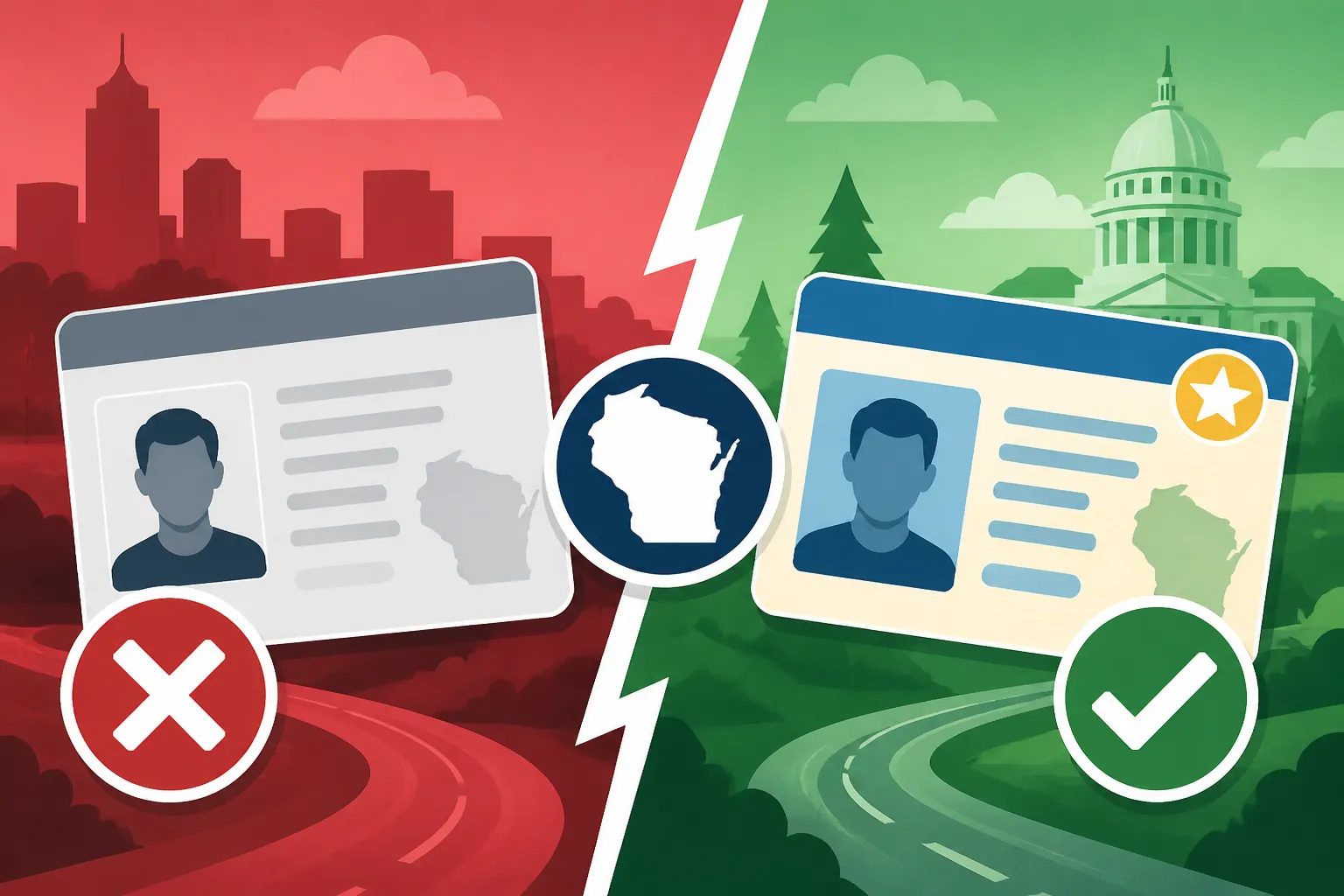
The main difference is what the credential is designed to satisfy. A standard Wisconsin license concerns driving authorization. REAL ID compliance concerns whether the credential meets federal identification standards. A non-compliant card can still be a state credential, but the federal-purpose marking tells you not to rely on it where a compliant credential is required.
| Question | Non-compliant Wisconsin card | REAL ID-compliant Wisconsin card |
|---|---|---|
| Does the card authorize driving? | The non-compliant marking alone does not determine driving privileges. Check the license’s validity and restrictions. | REAL ID status does not add or change driving privileges. Check the license’s validity and restrictions. |
| What does the status describe? | The card is marked as not for federal purposes. | The credential meets applicable federal identification standards. |
| Can it be used for everyday identification? | It may be accepted, depending on the organization and transaction. | It may be accepted, depending on the organization and transaction. |
| Is it appropriate for a federal-purpose requirement? | Do not assume it will be accepted; the card carries a federal-use warning. | It may satisfy a requirement for a REAL ID-compliant credential, subject to the rules for that purpose. |
| Does the label tell you the license class? | No. | No. |
| Does the label tell you whether the card is expired? | No. Check the expiration and current credential status. | No. Check the expiration and current credential status. |
The table is a starting point, not a guarantee of acceptance at every desk, checkpoint, or facility. Organizations can have their own procedures, and federal requirements can distinguish between types of identification or circumstances. If a trip or appointment depends on being able to prove your identity, confirm what is accepted with the organization responsible for that specific process.
It also helps to avoid treating “standard” and “non-compliant” as perfectly interchangeable in every conversation. People may use “standard license” to mean a license that is not REAL ID-compliant, but the card’s printed marking and the Department’s current terminology are more useful than assumptions based on casual wording. For more on the wording, see Keeping a Standard Wisconsin License Marked Not for Federal Purposes.
Another important distinction is that REAL ID is not a separate driver license class. A Class D license, for example, concerns the type of vehicle a person may drive under the applicable rules. REAL ID status concerns identification compliance. A change in the card’s federal-use status does not, by itself, turn a regular license into a commercial license, remove an endorsement, or grant new driving authority.
When the difference matters
The difference matters when you need an identification credential for a purpose with federal requirements. Some federally regulated settings may require a REAL ID-compliant credential or another form of identification accepted for that purpose. The appropriate document depends on the specific activity and current rules.
For air travel, do not rely on a general assumption that any driver’s license will be accepted as identification. Check the current identification requirements for your trip and confirm whether your card’s status is adequate. A passport or another accepted document may be an option, but what works depends on the applicable rules and the traveler’s circumstances. See Wisconsin REAL ID vs Passport for International Flights for a related discussion of credential choices.
For access to a federal facility, requirements can vary by facility and purpose. A REAL ID-compliant card may be relevant, but it is not a universal guarantee of entry. Some facilities may have additional screening or access rules, and an organization may accept other identification instead. Check with the specific facility before traveling there if access depends on your card.
For state and private transactions, the acceptance rules may be different. A bank, employer, school, retailer, or other organization may set its own identification requirements within applicable law. A non-compliant card could be accepted for one transaction and not accepted for another. Ask the organization what it accepts rather than assuming that “not for federal purposes” means “not accepted anywhere.”
The warning is especially important when you are making plans that are difficult to change. If you need identification for a flight, federal facility, or official process, check the rules before you leave home. If the card is marked NOT FOR FEDERAL PURPOSES, do not count on it to satisfy a federal requirement without confirmation.
The marking does not automatically tell you whether you have another acceptable document. If you have a passport or another credential, check whether it is accepted for your specific purpose and whether it must be current. If you do not have an alternative, find out whether the relevant organization has other ways to verify identity or whether you need to request a different state credential.
A compliant card is also not a substitute for checking practical details. A card can meet identification standards but still be expired, damaged, or unsuitable for a particular transaction. Confirm both the status of the document and the rules for the task. For the broader choice between credentials, see Wisconsin Driver’s License vs State ID: Which One Do You Need?.
What the federal-use marking does—and does not—tell you
Wisconsin Department of Transportation identifies NOT FOR FEDERAL PURPOSES as the marking on non-compliant Wisconsin driver licenses and ID cards. Read it literally: it flags the credential’s federal-use limitation. It is not a general statement that the card is invalid or unusable.
The marking does not tell you that your driving privilege has been suspended or revoked. Those are separate questions that concern your driving record and the current status of your license. If you are unsure whether you may drive, verify your driving status through the official Wisconsin Department of Transportation process rather than trying to infer it from the REAL ID designation.
It also does not tell you that the card cannot be used to identify yourself in a state-level or private transaction. Acceptance depends on the organization and the purpose. A card that is unsuitable for a federal identification requirement may still be useful as a state-issued credential or for an organization that accepts it.
The marking does not explain why a card has non-compliant status. Do not assume the reason from the text alone. The circumstances and documents involved in a person’s application can vary, and the card itself may not explain the underlying eligibility or application details. If you want to change the card’s status, use the official Wisconsin Department of Transportation instructions to determine the process and documentation that apply to you.
Finally, a REAL ID label does not answer every question about a card. It does not prove that a card is unexpired, that your personal information is current, or that a separate agency will accept it for a specific task. Treat REAL ID compliance as one credential feature, not an all-purpose approval.
How to check the status of your Wisconsin card
Start with the card itself. Look for the printed designation and read the complete wording. Wisconsin Department of Transportation says a non-compliant driver license or ID card carries NOT FOR FEDERAL PURPOSES. If that marking appears, do not treat the card as a REAL ID-compliant credential for a federal-purpose requirement.
If the wording is unclear, the card is worn, or you are not sure how to interpret it, check the Wisconsin Department of Transportation’s official guidance. Avoid guessing based on the card’s color, design, or the fact that it looks similar to another person’s credential. The printed text and the Department’s current information are more reliable ways to confirm the status.
Then check the card’s other details separately:
- Expiration: Confirm that the card is current for the transaction or trip.
- Name and personal information: Make sure the details match the records or documents that the organization will review.
- Credential type: Determine whether you have a driver license or a state ID, since their purposes differ.
- Driving status: If the question is whether you may drive, verify that separately. REAL ID status alone does not answer it.
- Purpose: Identify exactly where and how you plan to use the card, then check the rules for that purpose.
If you are preparing for a federal-purpose use, check the accepting agency or facility’s own instructions as well as Wisconsin Department of Transportation guidance. A credential’s status is only part of the answer; the organization responsible for access or identification can clarify what it accepts.
If you are reviewing someone else’s card, do not assume the person’s driving privileges from the federal-use text. The marking describes the card’s federal-purpose status, not the full licensing record. For a driver’s own license details, rely on official records and communications.
The related article Original Document Rules for Proving Wisconsin REAL ID Status can help you think about the documentation side of obtaining a compliant credential. For address documentation in particular, see Two Forms of Address Verification Needed for Wisconsin REAL ID. Because document requirements can depend on the application and individual circumstances, confirm the current list with the Department before preparing an application.
Deciding whether to keep your current card or seek a compliant one
The right choice depends on how you use identification. If your current card meets your needs and you do not expect to use it for a federal-purpose requirement, you may decide not to change it immediately. If you expect to travel or enter a facility that requires REAL ID-compliant identification, you may prefer to obtain a credential that meets that requirement or use another document the relevant organization accepts.
Consider the following before deciding:
- What tasks do you need identification for? Make a list of the situations where you present your license or ID. Separate state or private transactions from federal-purpose uses.
- Do you have another accepted document? Check whether a passport or other credential will work for the specific purpose.
- How soon do you need the credential? Allow enough time for the official application and delivery process. Confirm current processing expectations with the Department rather than relying on an old estimate.
- Do you have the required documents? Review the official requirements before making an in-person visit or beginning an application.
- Will your existing card remain useful? A non-compliant card may still serve other purposes, depending on the organization’s rules.
Choosing a compliant credential is not automatically the right decision for everyone. There may be no immediate need to change a card if you have other acceptable identification and do not expect to encounter a federal-purpose requirement. On the other hand, postponing the decision can create avoidable stress if a trip or appointment is approaching and your current card is not accepted.
Do not decide based only on a card’s design or on someone else’s experience. People can have different documents, different application circumstances, and different identification needs. Confirm what applies to you and verify the receiving organization’s requirements.
If you want to seek a compliant Wisconsin card, the official application process and document rules matter. See Upgrading to a REAL ID in Wisconsin: In-Person Document Requirements and Providing Your Social Security Number for a Wisconsin REAL ID for related issues to review. Use the Wisconsin Department of Transportation’s current instructions to confirm which documents apply to your situation and where to complete the transaction. Applications, payments, and credential requests must be completed with the official agency.
Common misunderstandings to avoid
“Not for federal purposes” means the card is invalid.
No. The text identifies a limitation on federal use. It does not, by itself, establish that the card is invalid for every other purpose or that the person cannot drive.
A REAL ID-compliant license gives a person more driving privileges.
No. REAL ID status concerns identification standards. Driving privileges depend on the license’s class, restrictions, and current status.
Any driver’s license will work as identification wherever a driver’s license is requested.
Not necessarily. A receiving organization may require a particular type of identification or may follow federal requirements. Confirm acceptance for the specific use.
A compliant card is automatically accepted for every federal purpose.
Do not assume that. The relevant organization may have additional requirements, and an alternative form of identification may be accepted. Check the current rules for the facility or transaction.
The marking explains why the card is non-compliant.
It does not. The wording tells you the federal-use status, not the individual circumstances behind the credential.
Changing to REAL ID is the same as renewing a license.
Not necessarily. An application to obtain or upgrade a credential can involve its own documentation and in-person requirements. Confirm the process with Wisconsin Department of Transportation before planning a visit. If you are also approaching a renewal, compare the instructions for Wisconsin Driver’s License Renewal: Notices, Deadlines, and Rules rather than assuming the two processes are interchangeable.
A useful approach is to separate the issue into two parts: first, determine whether your card is compliant; then, determine whether the organization you are dealing with requires that kind of credential. That simple check prevents both common errors: assuming the card cannot be used at all, and assuming it will be accepted for a purpose it does not meet.
Frequently Asked Questions
Does a Wisconsin non-compliant license let me drive?
The non-compliant marking alone does not determine whether you may drive. Check your license’s current validity and restrictions through the official Wisconsin Department of Transportation process.
What does NOT FOR FEDERAL PURPOSES mean?
Wisconsin Department of Transportation uses this wording on non-compliant Wisconsin driver licenses and ID cards. It signals that the card is not intended for federal purposes; it does not mean the card is invalid for every other use.
Can I use a non-compliant card as everyday identification?
Possibly. Acceptance depends on the organization and the transaction. Ask the organization what it accepts instead of assuming the card will or will not work.
Do I need REAL ID if I already have a passport?
Whether a passport works depends on the purpose and its applicable identification rules. Check with the organization responsible for the trip, facility, or transaction before relying on any document.
Sources
- Wisconsin Department of Transportation — Wisconsin DMV Official Government Site – Real ID (checked November 11, 2026)
- Wisconsin Department of Transportation — Wisconsin DMV Official Government Site – Real ID (checked November 11, 2026)
Disclaimer
This article is for general informational purposes only and does not constitute professional advice. Laws, prices and regulations vary by location and change over time. Consult a qualified professional for guidance on your specific situation. Wisconsin Driver Guide is not a government agency and is not affiliated with any state motor vehicle department.